

- Stereo and 2.1 stereo sound systems
- Commercial /BGM sound systems (100 Volt)
- Studio/Broadcasting Sound Systems
- Public Address (PA) & Sound Reinforcement Systems

Stereo and 2.1 stereo sound systems
Analyzing the above basic categories, and starting from the first one, we will simply mention that this is the simplest category which we encounter most frequently as it is addressed to a wide range of professions, which are practiced in office spaces. The implementation of these systems does not require special knowledge, as each of us can implement such a system, even in their basic form such as that of desktop audio, i.e. simple autonomous sound systems. In other cases where our requirements are greater – such as in a multi-office space – there is the possibility of such sound systems, as long as we choose the appropriate speakers to serve this condition, as well as the appropriate amplifier that will drive them (such as the case of the multi-zone amplifiers we encountered above).

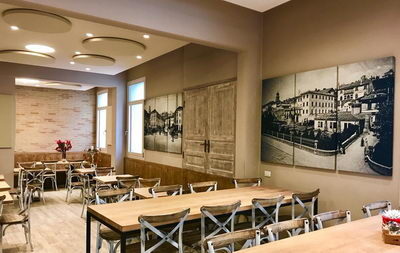
- Commercial /BGM sound systems (100 Volt)In the second major category, we find Commercial / BGM speakers, which consist of speakers and special-shaped amplifiers. More specifically, these systems operate in places where background music (BGM) or announcements are required. Such places are commercial stores, restaurants, hotels, educational institutions, etc.A standard stereo amplifier and a few pairs of speakers could provide a small business, such as a restaurant, with adequate background music, but this would not work well in a system with many speakers and long cable runs. Classic stereo amplifiers reproduce a low voltage - high power signal, which in order to power the speakers requires large cross-section cables and complex connections between the speakers. This very condition greatly increases the cost of installing a conventional system, making this option unprofitable.By using instead special systems which carry a 70/100 Volt voltage transformer, and “loading” the audio signal onto this high voltage, we achieve a drop in the requirements for transmitted power through the cables and consequently our requirements for large cross-sections. At the same time we use a single cable per sound zone regardless of the number of speakers present in the space, while at the same time our requirements for different amplification devices are reduced. In this way we automatically reduce the cost of the installation, which is important when creating a new professional space.

Studio/Broadcasting Sound Systems
In the category of studio & Broadcasting sound systems, we mainly encounter small speakers, each with its own amplifier and of high quality, in order to provide us with the best and most faithful reproduction of sound in the workplace. It is easy to understand that in a studio, the requirements for proper listening are high as we must receive with our ears the sound as it is reproduced by the primary source, such as a singer, or a group of musicians. We encounter a similar condition in professional broadcasting spaces such as a radio station.

- Public Address (PA) & Sound Reinforcement SystemsThe next category of sound we are examining is also large, as it includes any installation of live sound reproduction, whether it comes from a group of musicians, or is reproduced through music machines such as CD players, by a DJ.As for the composition of the equipment, we would say that it is simple in terms of its basic structure, as it consists of conventional speakers and high-power amplifiers. However, we should seriously consider that in order to proceed with the procurement and installation of the appropriate system for our professional space, we should definitely contact the appropriate professional systems consultant, as specialized knowledge and extensive experience are required.In an attempt to approximate the way this category works, we could say that a microphone, a sound mixing console, an amplifier and a pair of speakers constitute a small PA system. Usually, of course, in this category we encounter systems consisting of much more elements. More specifically, to compose a PA system we use:

- MAIN SPEAKER SYSTEM:
These speakers fall into two categories. Active speakers are powered, meaning they have built-in amplifiers. All that is required is to connect the sound source (microphones, instruments, etc.) directly or connect them via a sound mixing console. Passive speakers are not powered, meaning you will need to add an external amplifier. There are advantages and disadvantages to each type of speaker, and the final choice largely depends on how you plan to use your PA system. For example, active speakers are more commonly used in situations where they need to be transported frequently, while passive speakers are the ideal solution for permanent installations.

- HXEIA SUBWOOFERS:
Subwoofers are used to amplify the low frequencies of music, and to add depth to any type of music, but especially to dance music. If the PA is intended for speeches and lectures, folk music, or a choir, then a subwoofer is probably not needed.

- HXEIA MONITORS:
Monitors are speakers that are set up so that musicians can hear the music they are playing above the noise of the crowd and the diffuse sound of the central speaker system in the space, and thus be able to perform better.

- AMPLIFIERS:
If we choose to equip our space with passive speakers, we will also need to purchase the appropriate amplifiers to drive them. The power of each amplifier should be at least equal to or even better greater than the nominal power of the speakers in order to ensure sound clarity and avoid distortion.

- MIXING CONSOLES:
Mixing consoles are the heart and control center of PA systems. All music and sound sources can be mixed in the mixing console, and then sent to the amplifiers and speakers. Each mixing console has volume and tone controls for each input channel, giving the user the ability to balance the individual signals and create a clean output signal.

- SOUND PROCESSORS:
Most of the sound processing required for a PA system to perform properly is usually built into the mixing console and amplifiers, and is mostly sufficient, especially when it comes to a small basic system. However, larger systems require the ability to be more finely tuned to the space, and so the addition of sound processors is a one-way street in our options. Sound processors incorporate the following:- Equalizers: Equalizers are used to adjust the sound so that the sound effect is adapted to the space. This adjustment is performed per frequency of the sound (linear eq), or per frequency range (parametric eq).
- Limiters: Limiters are used as system safety devices, as they set limits on the final output power of the amplifier so that it does not exceed the capabilities of the speakers it drives.
- Effects: Our effects units provide the ability to color the sound in order to create a more pleasant and impressive result for the audience.